







Fronts and Low Pressure Systems
Ever wondered how the low-pressure systems that bring rain to Spain are formed? Behind each system lies a fascinating process that begins thousands of kilometers away, where air masses with opposite characteristics collide in the so-called "Polar Front". In this guide you'll learn how the lows that affect our weather are born, grow and die.
What is a Weather Front?
A front is the contact zone between two air masses with different characteristics, especially in temperature and humidity. Imagine two armies clashing: cold air (dense and heavy) against warm air (light and humid). This battle creates the most spectacular weather phenomena.
Types of Fronts
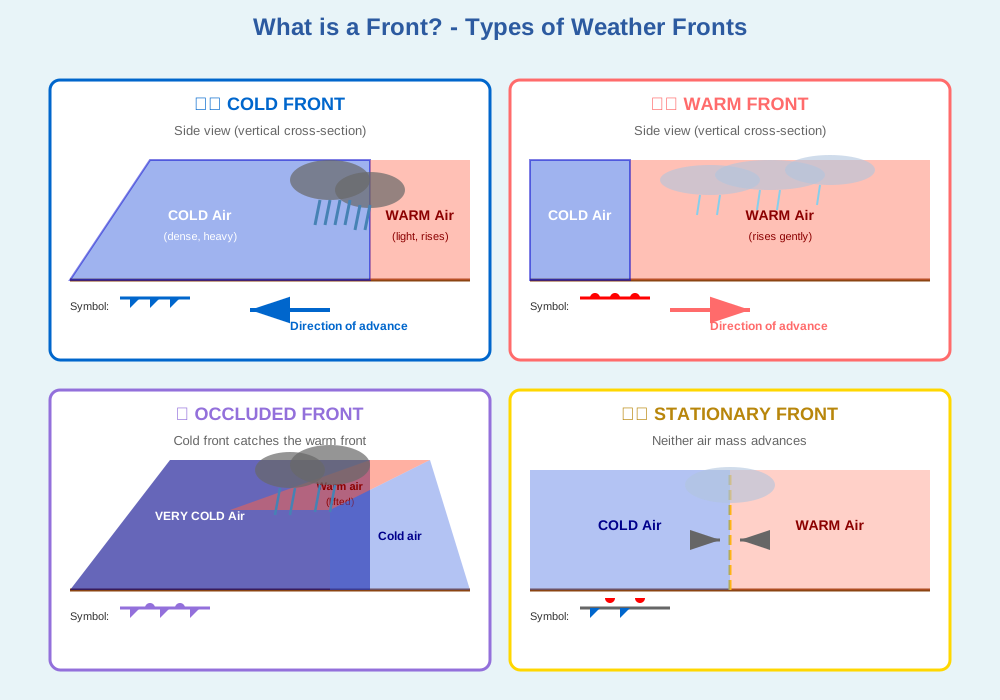
There are four main types of fronts, each with unique characteristics and symbols on weather maps:
1. Cold Front ❄️
Characteristics:
- Cold air (dense and heavy) advances pushing warm air
- Warm air is forced to rise abruptly
- Produces vertically developing clouds (cumulonimbus)
- Intense but short-duration rain
- Possible thunderstorms, hail, heavy showers
- Sharp temperature drop after passage
- Rapid weather improvement afterward
Symbol: Blue line with triangles pointing in the direction of movement
2. Warm Front 🌡️
Characteristics:
- Warm air advances gently sliding over cold air
- Gradual ascent of warm air
- Produces stratiform clouds (in layers)
- Persistent but moderate rain
- Can rain for hours or days
- Gradual temperature increase
- Reduced visibility, gray sky
Symbol: Red line with semicircles pointing in the direction of movement
3. Occluded Front 🌀
What it is: Forms when a cold front (moving faster) catches up with a warm front. Warm air becomes trapped and lifted between two cold air masses.
Characteristics:
- Combination of cold and warm front
- Variable weather: can have intense AND persistent rain
- Multiple types of overlapping clouds
- Marks the beginning of the end of the low
- Common in mature lows
Symbol: Purple line with alternating triangles and semicircles
4. Stationary Front ⏸️
What it is: Neither air mass can advance. They remain "pushing" each other without moving.
Characteristics:
- Remains in the same place for days
- Persistent rain over the same area
- Can evolve into a low if it undulates
- Common in summer (less active)
Symbol: Line with blue triangles on one side and red semicircles on the other (pointing in opposite directions)
The Polar Front: The Storm Factory
Now that we know what fronts are, we can understand where the lows that affect Spain are born.

What is the Polar Front?
The Polar Front is a permanent zone (although it shifts) located approximately between 40°N and 60°N where these constantly collide:
- Polar Air: Cold (-20°C to -40°C), dense, dry, coming from the Arctic
- Tropical Air: Warm (+10°C to +25°C), light, humid, coming from subtropical latitudes
This contact zone is NOT a straight line, but is constantly undulating, moving up and down in latitude. Spain (40°N) is right in the battle zone.
The Jet Stream
At 9-12 km altitude, right above the Polar Front, flows a river of wind at incredible speeds: 200-400 km/h. This is the jet stream.
How a Low Pressure System Forms: The Complete Cycle
The lows that bring rain to Spain are extratropical lows (also called "mid-latitude depressions"). They follow a well-defined life cycle that was discovered by Norwegian meteorologists in the 1920s:
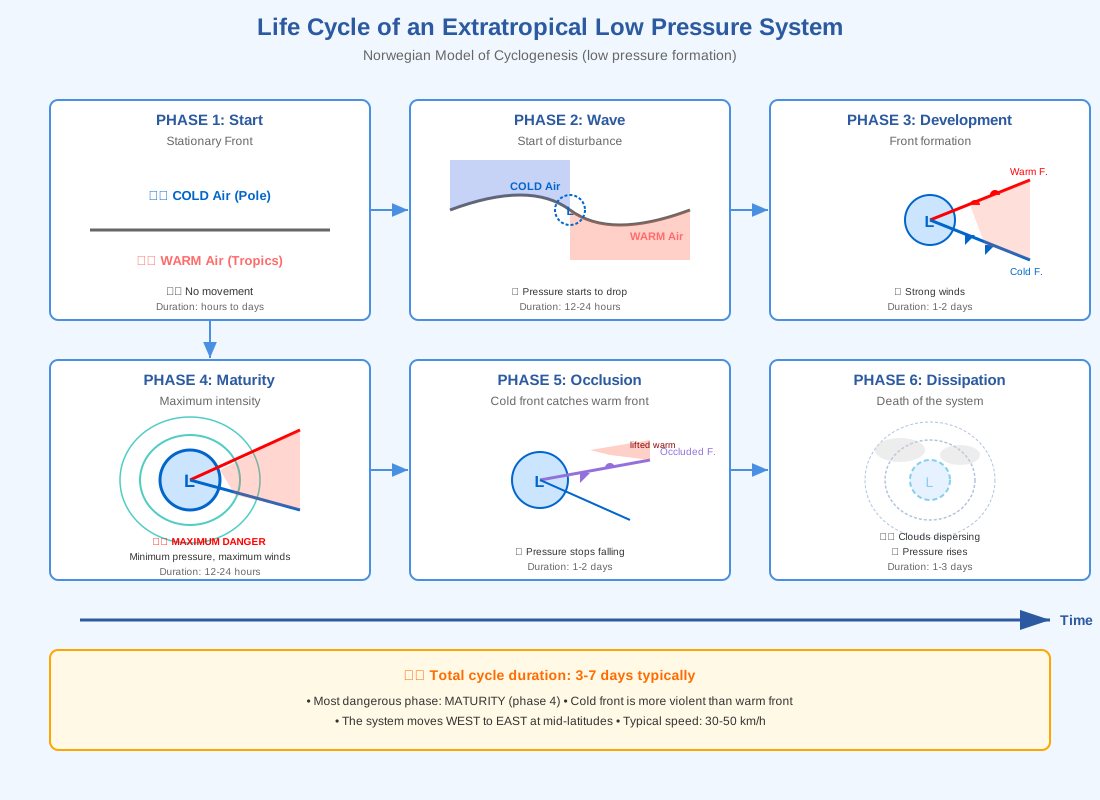
PHASE 1: Stationary Front (Beginning)
Everything starts with polar and tropical air separated by a stationary front. Neither advances. Stable yet unstable situation.
Duration: Hours to days
PHASE 2: Wave Formation (Disturbance)
Something (usually an undulation of the jet stream aloft) causes the front to begin curving. Warm air starts "pushing" northward forming a small warm "tongue".
Pressure at the center of the wave starts to DROP. A small low pressure system forms.
Duration: 12-24 hours
PHASE 3: Development (Youth)
The wave becomes more pronounced. There is now clearly:
- A low pressure center (cyclone)
- A warm front advancing northeast
- A cold front advancing southeast
- A warm sector between both fronts
Winds begin blowing strongly, rotating counterclockwise (in the Northern Hemisphere) around the low pressure center.
Duration: 1-2 days
PHASE 4: Maturity (Maximum Intensity) ⚠️
The low reaches its maximum power:
- Pressure at minimum (can drop to 950-970 hPa)
- Maximum winds (can exceed 100 km/h)
- Intense rain in the cold front
- Persistent rain in the warm front
- Well-defined warm sector
Duration: 12-24 hours
PHASE 5: Occlusion (Old Age)
The cold front (moving faster because cold air is denser) catches up with the warm front. Warm air becomes trapped and lifted. An occluded front forms.
Pressure stops dropping. The low begins to "die".
Duration: 1-2 days
PHASE 6: Dissipation (Death)
The low progressively weakens:
- Pressure rises
- Winds calm down
- Clouds disperse
- Rain stops
Remnants of the low can persist as high clouds for days.
Duration: 1-3 days
Key Characteristics of Extratropical Lows
- Total cycle duration: Typically 3-7 days
- Movement speed: 30-50 km/h (from west to east)
- Size: 500-2000 km diameter
- Central pressure: 950-990 hPa (lower = more intense)
- Season: Most frequent and intense in autumn-winter
- Typical origin: North Atlantic, at the latitude of Iceland-Scotland
Why Do Lows Move from West to East?
Three main factors:
1. The Jet Stream
The jet stream flows from west to east, and "drags" lows along with it like leaves in a river.
2. Earth's Rotation
The Coriolis effect causes everything moving in the Northern Hemisphere to tend to deflect to the right. This reinforces eastward movement.
3. General Atmospheric Circulation
At mid-latitudes (40°N-60°N), prevailing winds aloft are from the west (Westerlies).
Differences: Atlantic vs Mediterranean Lows
🌊 Atlantic Lows (typical)
- Form in the North Atlantic
- Follow the classic Norwegian model
- Bring moist air from the ocean
- More affect northern and western Spain
- Abundant but less torrential rain
- More predictable (can be seen 3-5 days ahead)
🏖️ Mediterranean Lows (more dangerous for the east)
- Form in the Mediterranean (rarer)
- Smaller but very intense
- Fueled by the warm Mediterranean
- Especially affect the Levante region
- Can generate TORRENTIAL rains
- Less predictable, more stationary
- Similar to weak tropical hurricanes (medicanes)
Why Are There More Lows in Winter?
The thermal contrast between pole and tropics is maximum in winter:
- In summer: Pole at -10°C, Tropics at +25°C → Difference: 35°C
- In winter: Pole at -40°C, Tropics at +15°C → Difference: 55°C
Greater contrast = more available energy = more intense and frequent lows.
Additionally, in summer the Polar Front retreats north (60°N-70°N), away from Spain. In winter it descends to 40°N-50°N, right over us.
Signs That a Low is Approaching
Although we now have satellites and models, you can observe these signs:
- ☁️ Cirrus clouds (high feathers) appearing from the west → Warm front 24-48h away
- 📉 Pressure dropping on the barometer → Low approaching
- 🌬️ Wind rotating from south to southwest → Warm sector arriving
- ☁️ Sky covering progressively → Front hours away
- 🌧️ Persistent rain → Warm front passing
- 💨 Strong west wind + shower → Cold front passing
- 🌤️ Sky clearing rapidly → Low moving away
Conclusion
Extratropical lows are the daily meteorological bread and butter in Spain. Far from being enemies, they are fundamental to our climate: they bring the rain that fills reservoirs, irrigates fields and maintains our ecosystems.
Understanding how they form, their life cycle and their associated fronts allows you to:
- Better interpret weather maps
- Understand why it rains differently at different times
- Predict what weather is coming in the next few hours
- Appreciate the work of meteorologists
💡 Remember: Next time you see a low on the weather map, it won't just be a "L" with lines. You'll know it's a titanic battle between air masses, with fronts as battlefields, following a predictable cycle from birth to death.
Was this guide helpful? Also check our guides on Isobar Maps and DANAs.